
How to Rank in LLMs 2026 guide
A practical guide to ranking in LLMs: what fan-out queries are, how to rank in ChatGPT, get your brand mentioned in Claude, and show up in Google's AI answers.
So, how do you rank in LLMs?
This is the question everyone and their grandmother is asking these days (only half exaggerating). The industry is a couple of years old, fundamentals change every other week, and yet everyone already claims to be the "AEO/GEO/AIO…" expert on TikTok, Instagram, and LinkedIn. If you feel behind, don't fret. It's less complicated than the experts make it sound, and I'm here to prove it to you.
First, what even is an LLM? Why does everyone suddenly want to rank in it, and why is the average AEO agency retainer $8,000 a month while a traditional SEO retainer sits around $3,000?
LLM stands for Large Language Model, essentially a big next-token prediction engine trained on trillions of data points and millions of gallons of water. These models have a tool called web search, which they use to find up-to-date answers and grounding sources when you prompt them with things like "who has the best burger in town?" or "best running shoes for beginners" at 3am when you get the sudden urge to get in shape in a random night. Behind that web search tool sits an actual search engine: Bing and a few scrapers for ChatGPT, Brave Search for Claude, and of course the big G for Google's own AI.
So if you strip away all the other variables, these gee-pee-tees are just doing a web search on the user's behalf, on their respective search engines. Once the results come in, they re-rank and summarize based on their own system prompts and trust preferences, then compile one final answer. If you want to sound fancy, call this step "synthesis."
You've probably already forgotten half of what you read, so let me illustrate:
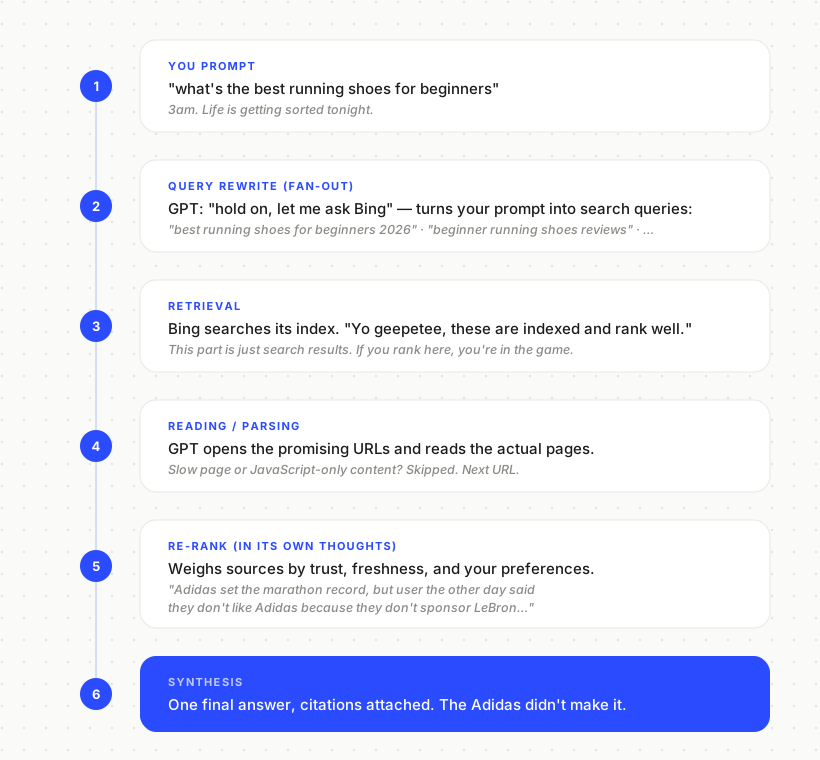
Of course, this is an extremely dumbed-down version, just so you get the idea. If you only wanted to sound smart enough to put "AEO Expert" in your LinkedIn bio, congratulations, you now know as much as 95% of the online experts in this field. You're ready.
From here on is serious talk. The inner workings vary a lot between models. Claude is the most straightforward, ChatGPT is the most complex, and Google's is all over the place. So here we go!
How ChatGPT picks its sources
When you prompt ChatGPT, it first decides where to pull grounding sources from. From our research, supported by independent SEO/AEO people in the industry, ChatGPT routes searches through several retrieval pipelines. When you inspect ChatGPT's responses you see a result_source label on every web result it fetches, with four observed values: SERP, Labrador (a licensed-publisher tier with established publishers and reference sites), Bright (Bright Data), and Oxylabs. Two of those are commercial data scrapers, which ChatGPT seems to use when it has the information in its own index (ChatGPT is building its own web index!). The topics were mostly shopping, finance, weather and local queries.
When this was tested with 1,000 prompts and nearly 10,000 completed search runs, Labrador accounted for about 80% of primary sources, Bright around 10%, Oxylabs and SERP shared the rest. Some prompts changed their primary source across repeated runs, so the same question can be answered from different pipelines on different days, times or who knows when else.
And more recently, Bing started to show up as a regular source type. Bing was the default search engine for GPT since web search was introduced. Now it is demoted to just being one of the options. So, if you peel enough layers back, it is all still search, with the model re-ranking and personalizing on top according to its system prompts and whatever mood it woke up in.
The parsing side varies too. Sometimes ChatGPT reads a URL through 3rd party HTML parsers, sometimes it loads the entire HTML, sometimes it just scans titles and descriptions off the SERP. So to kill any variability, it's best to serve already rendered, semantic HTML or Markdown.
So what does all this mean for you? As long as you are in one of the big two indexes, you will get picked up as a citation. Google reaches ChatGPT through the Bright Data and SERP sources, and Bing now shows up on its own. What you need is to rank well in those indexes, or to be mentioned for related keywords and topics on pages that are ranking. Whether you go into the actual shortlist ChatGPT recommends depends on the content of the pages you are mentioned on, and of your own site.
ChatGPT's own index now seems broad enough that for some searches the model just decides which website to fetch from directly, using the commercial crawlers I mentioned above, but that's still limited. It confirms once more that OpenAI is developing their own web index and may stop relying on Google, Bing and other external indexes in the future.
There is not much information available on how to get into ChatGPT's own index, apart from not blocking its training bots. I imagine they will open up something similar to Web Master or Google Search Console once they reach a certain scale. In the meantime, you will get into ChatGPT's answers by ranking for the fan-out queries on the other search engines.
If you're on Encited, the fan-out queries for your tracked prompts are on your dashboard overview, in the Fan-out Queries panel, with the per-prompt breakdown on the Prompts page.
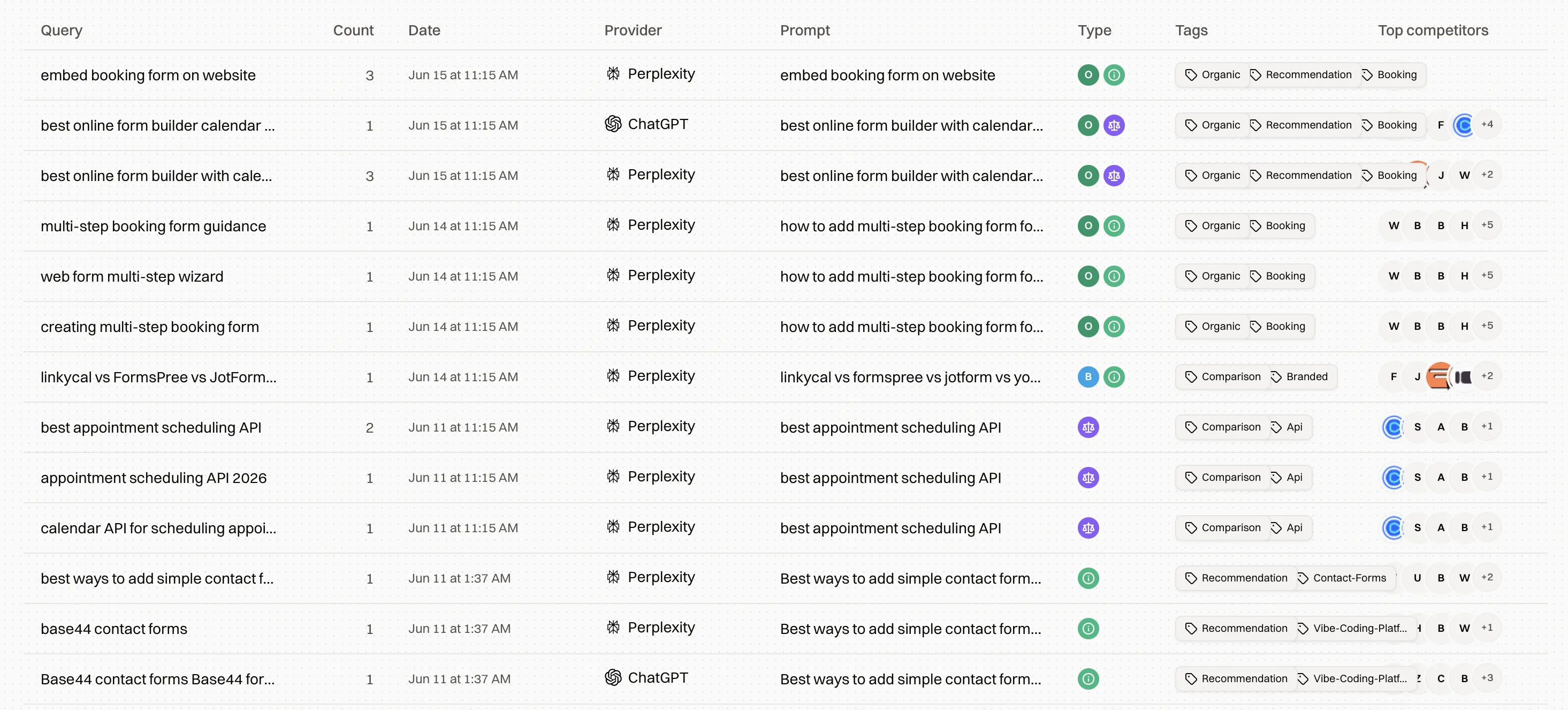
For the sources, look for "Citations" in the left sidebar. That's the list of sites AI is already pulling answers from, aka your off-site citation targets:

How Claude picks its sources
Getting URLs cited in Claude is straightforward, at least compared to ChatGPT. Its access to the open web is almost always linear: it searches through Brave and weights the options. The result list it pulls is almost identical to what you see searching Brave yourself. So ranking well on Brave means getting your URLs cited, most of the time. I posted a direct comparison of URLs Claude pulled and the Brave SERP page on my LinkedIn for the 5 people that follow me.
So how do you rank in Brave? Unlike Google, Brave has no dashboard to work on your indexing or check impressions. What you can do is submit your URLs and hope some of your visitors use the Brave browser, because browsing data is part of what feeds the index and gets new URLs found and evaluated. Brave's crawler is partly powered by the Web Discovery Project, an opt-in setting in the Brave browser.
Claude also does its own reading of the URLs it finds in the SERP. If your pages are slow or can't be read without JavaScript rendering, it skips and moves on to the next one, very fast. If your page is slow, Claude's web fetcher backs out and your server logs a 499, we see this a lot in legacy storefronts like Magento and of course the SPAs. So make sure your pages load fast, are parseable, and don't need JavaScript to run before the content you want indexed shows up. This is exactly what Encited handles: we prerender your dynamic pages and serve them from the edge in milliseconds, as plain HTML or Markdown depending on what the crawler asks for.
Claude's fan-out queries are unusually long, and it appends the year when the search is time sensitive. You'll often see several queries stacked into one long record, most likely to keep the Brave Search bill down. If an odd-looking query comes up often enough and it's relevant to you, that's a chance to refresh a page and capture it.
How Google's AI (AI Overviews, AI Mode, Gemini) picks its sources
Google's AI surfaces all run on the same underlying machinery: Gemini grounded in Google's own index, Knowledge Graph, and Shopping Graph. The retrieval technique has a name the industry settled on: query fan-out. Google's own patent US11663201B2 describes it as "query variant generation": take one search query, generate multiple related variants with a trained generative model, issue each separately, and synthesize the combined results into one response.
In practice, when you ask AI Mode something like "book a vacation for a family of 5 around the U.S.", it quietly runs sub-searches like "family-friendly activities" and "road trip for families" in parallel, then stitches the strongest passages into one cited answer. The sub-queries we process reveal exactly what entities and themes the model breaks a prompt into, and Google itself said the fan-out technique got a major upgrade with Gemini 3.
The implication is the same as with Claude and ChatGPT: you're no longer competing for one keyword. You're competing across a dozen sub-queries per prompt, most of which you never explicitly targeted.
Okay, so how do I actually rank?
Enough theory - here is the process. This is how we do AEO tracking and optimization ourselves at Encited. You want to do it in order for about a month, re-evaluate at the end, rinse and repeat.
Step 1: Pick your prompts. Sit down and write 10-20 prompts your actual customers would type, in their words, their lingos etc. If you do not know where to find them, go to your Search Console and copy a few of those keywords into ChatGPT and ask it to generate some. For Encited users, we bought a massive clickstream feed from a known data company, so we have this feature where you can search and explore real prompts in Add prompts -> Explore tab (screenshot below). But since the industry is new, no one has data that covers everything fully. If you are in some super niche locale or industry, the manual approach in the beginning is still the move.
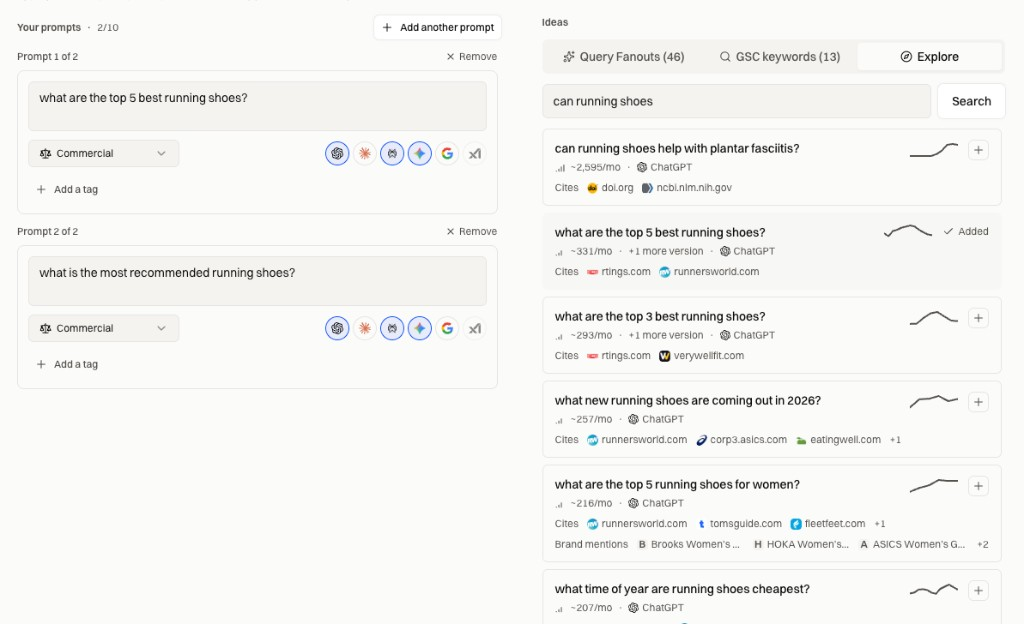
You want to have them properly split into stages of search intent. Informational, where someone is just looking for info ("do cushioned shoes actually help knee pain"). Commercial, where they are comparing options ("best running shoes for knee pain", "brand X vs brand Y"). Transactional, where they are ready to act ("brand X model Y discount code", "where to buy"). And brand, where they are asking about you directly ("is brand X legit", "brand X reviews"). You do not need equal amounts of each, but you want at least a few in every stage, because models behave differently at each one and you want to see where you are leaking.
Step 2: Split them into two groups. One group is your bread and butter, the brand prompts that should always be yours, the ones you always want to keep an eye on for new competitors, algorithm and behavior shifts, and any other changes in your competitor landscape and in the LLMs themselves. The second group is the prompts you want to win but don't show up in yet.
You want to repeat this for every keyword cluster, topic or locale you have. This part totally depends on your preference on how you split it, but do not overdo it, keep it manageable.
Step 3: Find out what the models are doing with them. Run every prompt in both groups and collect two lists. First, the fan-out queries: the actual searches the models fire off behind each prompt. These tell you what the model thinks the prompt is really asking, and each recurring one is a page you could be ranking for. Second, the citations: the URLs the models read and quote when answering. These tell you which pages already have the model's trust for your category, meaning who you need to outrank or get mentioned by. Note which competitors keep coming up too, they are your benchmark for the rest of the loop.
Encited tracks both of these daily for every prompt you add. If you don't have a tool yet, run each prompt yourself, open the search steps the model shows, and copy the queries and cited URLs into a spreadsheet. Painful, but it gets you started.
For example, this is what a tracked prompt looks like once the runs pile up: every model it ran on, whether you got mentioned, and the exact queries fired behind it.
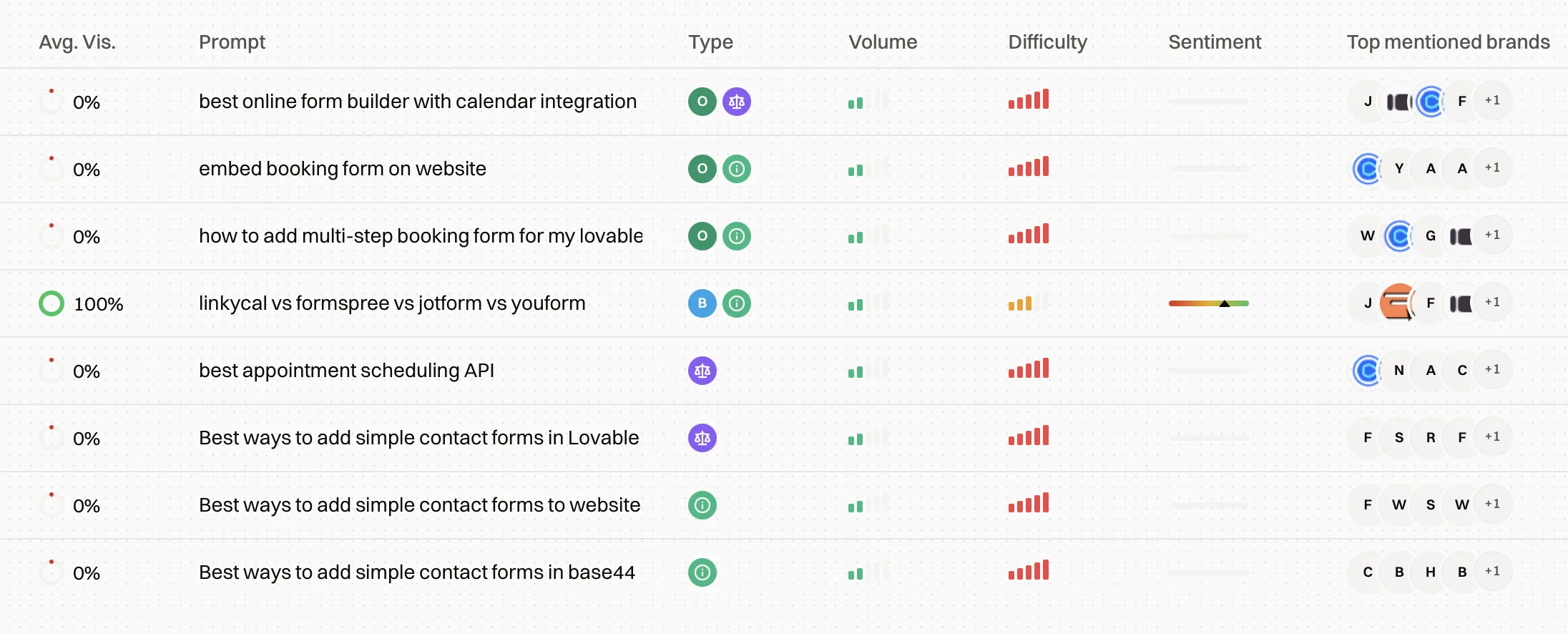
Step 4: Get the fundamentals right. Once you have some idea on the type of content you will be putting out, make sure your pages load fast, are readable and do not require JavaScript to read. This does not only mean SPAs. Dynamically loaded content once the page is in browser, click to reveal text, modals and drawers, accordions - make sure these pieces of content are available without having to render the page. Over 90% of AI crawlers do not execute JavaScript and they are just dumb fetchers. So make sure you run a technical SEO audit to verify your content is visible and your HTML is semantic. Encited can turn your pages into plain HTML including its dynamically loaded content and serve from the edge in milliseconds as HTML or Markdown to crawlers, try it out for 14 days with no credit card here.
Step 5: Put out content targeting the fan-out queries. Once you let it run for some time, you should have some data on the web queries these AI bots are running. Take them, turn them into content clusters and start writing content targeting those queries. Write something tangible, seriously, no slop. It is not that hard to research and find something interesting related to these queries to write about, or at least improve on what's already ranking.
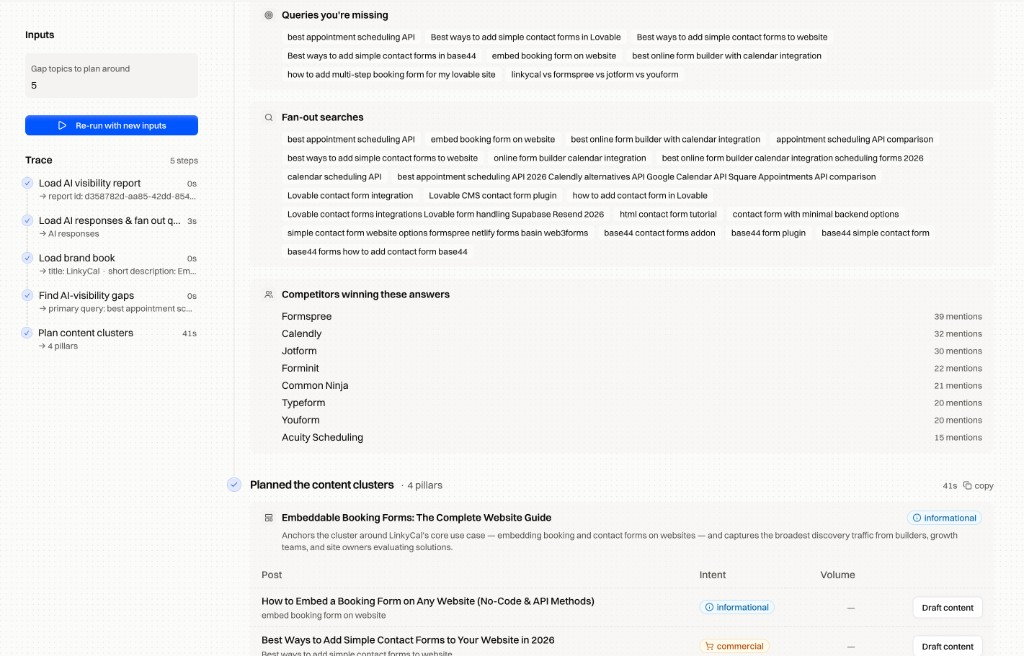
Step 6: Get mentioned where they already look. Take the citations list and work your way into it. Pitch the roundups, answer the Reddit threads that keep getting cited, republish on LinkedIn, get featured in the publications that show up. A mention on a page the model already trusts is worth more than ten new pages it hasn't found yet. The Actions tab digs these opportunities up for your brand so you don't have to.

Step 7: Wait, then re-evaluate. Give it 2-4 weeks for the new content to get picked up and the new off-site citations to start affecting the results. If your content is getting cited but you are not moving in the shortlist, then it means you need to make it more specific and indirectly refute or prove why your solution is better - you will be doing circus tricks for this LLM judge at this point.
If you are getting cited and the AI's consensus is wrong - most common problem, then you need to clean up the information you have in places where AI is pulling from: outdated directory descriptions, unaddressed reviews, bad PR etc. This side goes into a different territory so I will leave it to experts to talk about. One last-ditch effort could be to buy an exact match domain to the fan-out query and just say good things about your brand on there - exact match domains still work for LLM ranking.
I know this is a lot of work but it is free and possibly evergreen traffic and it is still easier than ranking in traditional SEO, especially for new sites. A few well placed citations, a couple of digital PR campaigns and a few solid pieces of content can get you in top results consistently for months, possibly years, even though the industry is too young to say years.
Local SEO specific tips
For local queries ("best dentist in Austin", "burger near me"), the models lean on the same sources local SEO has always leaned on: Google Business Profile, review platforms, and local listicles. ChatGPT's commercial scrapers were found to be especially active on local queries when tested, and OpenAI has since started licensing local review data directly (Yelp being a recent example).
So the playbook here is boring on purpose. Keep your business profiles complete and consistent. Accumulate genuine reviews, ideally ones that mention your actual services, because "great root canal, barely cried" does more for you than "nice place." And get into the "best X in [city]" roundups for your area, because those roundup pages are what the models actually read to form an opinion about you. Your own site mostly supplies the facts (hours, address, services), so make sure those are in plain HTML the fetchers can parse.
Ecommerce specific tips
For product queries, the model rarely takes your word for it. It reads your product page for the facts (specs, price, availability) and reads everyone else's pages for the opinion: review sites, comparison articles, Reddit threads, "best X for Y" listicles.
On your side, make product pages fast, parseable, and rich in structured data. Product schema with price, availability, and ratings. A spec sheet trapped in a JavaScript render or baked into an image simply does not exist as far as the fetchers are concerned.
On everyone else's side, work your way into the comparison and review content the models cite for your category. Your Citations page shows exactly which roundups those are, so start there. One more thing: shopping fan-out queries lean hard on "best" and "top" with the current year appended, so keep your comparison content fresh and keep the year in it.
None of this is clever. Fast pages, plain HTML, submit your URLs, get mentioned where the models already look, and pay attention to what they're actually searching for.
— Aki, Founder at Encited