
Find who gets cited instead
When an assistant looks something up mid-answer, it opens specific pages. Citations lists those pages, so you can go and get named on them.
Time: 15 minutes. You need: prompts that have run at least once.
1. Open Citations#
Go to Monitor → Citations. Every row is a URL an engine opened while answering one of your prompts.
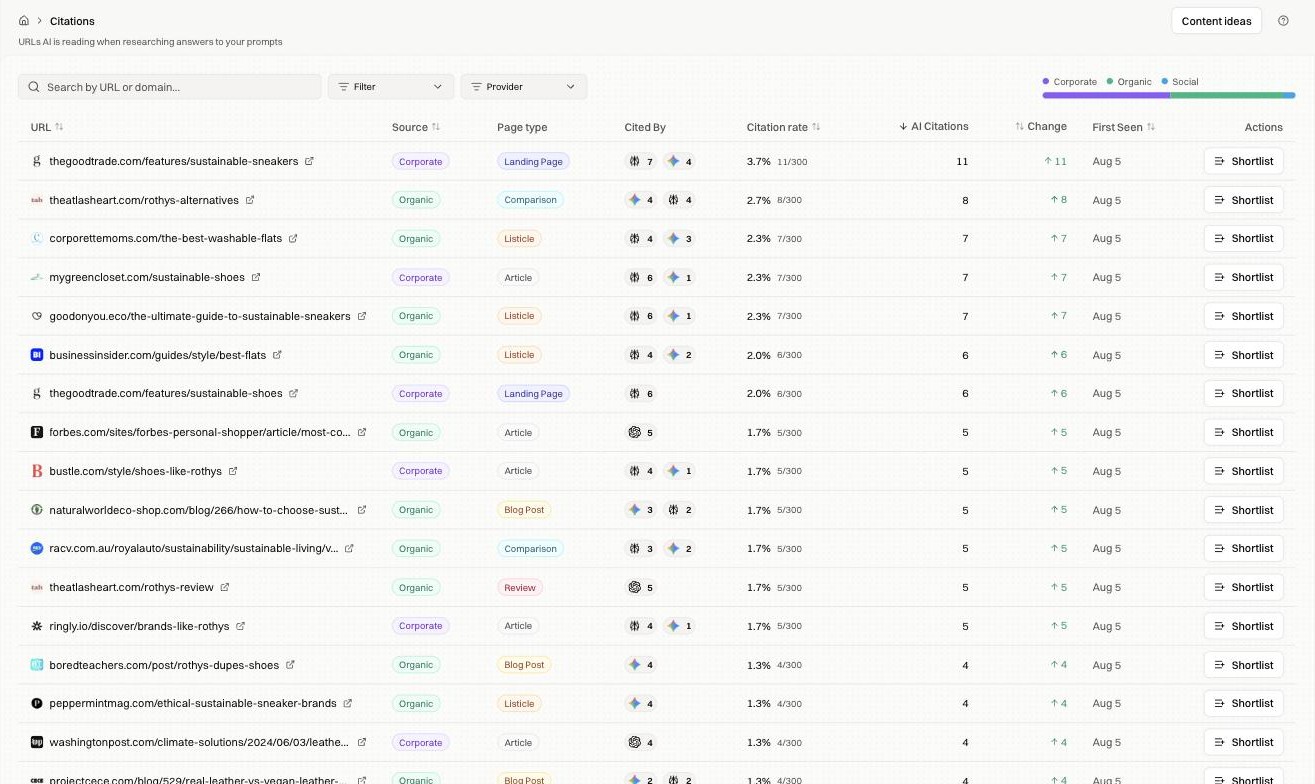
| Column | Reading it |
|---|---|
| URL | The page that was read |
| Source | Corporate, Organic, or Social |
| Page type | Landing Page, Comparison, Listicle, Article, Blog Post, or Review |
| Cited By | Which engines read it, and how many times each |
| Citation rate | How often it appears across all your tracked answers |
| AI Citations | Total citations in the period |
| Change | Movement since the previous period |
| First Seen | When it first appeared |
2. Sort by citation rate#
The pages at the top are the ones shaping answers in your category. Skip past your own domain and read what's left.
Page type tells you what kind of opening you have:
| Page type | What to do about it |
|---|---|
| Listicle | Easiest to act on. "Best X for Y" posts get read constantly and their authors usually accept updates. |
| Comparison | Worth pitching if you're absent or described wrongly. |
| Review | Check the verdict, not only the mention. |
| Article, Blog Post | Slower to move, and a good place to be quoted. |
| Landing Page | Usually a competitor's own page. Treat it as a signal of who's winning. |
3. Shortlist the ones worth pursuing#
Click Shortlist on a row to keep it. Build a list of pages that are cited often, that you're missing from, and that a human could plausibly update.
A page cited across many of your prompts carries more weight than a page cited heavily on one.
4. Filter by engine when they disagree#
If one engine names you and another never does, use the Provider filter to see each engine's sources separately. Engines that disagree are reading different pages, and the filter shows you which.
5. Turn it into work#
Content ideas at the top right takes the citation set and proposes pages to write. Use it when the gap is something you should own rather than something you should be listed on.
Fixes by symptom#
| Symptom | What it means |
|---|---|
| Your own domain barely appears | Engines aren't reading your site. Check Inspect & Optimize → Pre-rendering. |
| One competitor's landing page dominates | They own the category answer. Target the listicles that rank them. |
| Citations are mostly forums | Community opinion decides your category. Being present in those threads outweighs publishing. |
| Citation rate is low across every URL | Engines are answering from memory rather than looking anything up. Being cited elsewhere outweighs your own pages. |
FAQ#
Are these the same as backlinks? No. A citation means an engine opened the page while composing an answer. It says nothing about whether the page links to you.
A page cites us but we still show 0% visibility. Being read isn't being recommended. Open the answer text on the prompt to see how you were described.